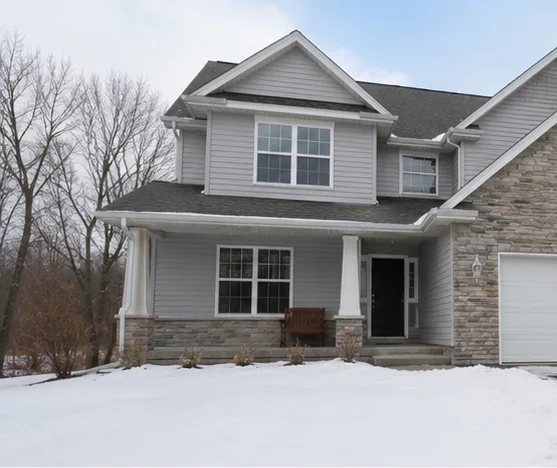
Split-level and split-entry homes are everywhere in Coon Rapids. Builders filled the Anoka County sandplain with them through the 1960s, 70s, and 80s, and today they make up a big share of the resale market north of the river. A split-level looks simple from the curb, but the half-flight transitions, stacked roof planes, and partially below-grade lower levels create inspection concerns you will not find in a one-story rambler. We focus on how these homes actually age in the northern Twin Cities climate: ice dams on the upper roof, moisture seeping into the half-buried lower level, aging original mechanicals, and the panels and sewer laterals common to this vintage. Below is what we look at, why it matters here, and how a careful inspection protects your offer before you close.
Half-Level Transitions and the Split-Entry Floor Plan
The defining feature of a Coon Rapids split is the half-flight staircase. In a true split-level you step up to bedrooms and down to a family room; in a split-entry (or 'split-foyer') you walk into a landing between two short flights. Those short runs are where we look hard at stair geometry. Many homes from this era were built before modern code on riser height, tread depth, handrail graspability, and guard spacing, and decades of carpet-over-carpet and DIY railing swaps make them worse. We check that handrails are continuous and secure, that guards at the open landing are tall enough and tight, and that risers are uniform so a step does not surprise someone. We also study how the floor framing changes height at the split. The transition often hides a beam, a bearing wall, or a header, and we look for sagging, notched or drilled joists, and amateur basement-finishing work that removed support. Because the levels are offset, plumbing and HVAC runs snake through these transitions, so we trace ducts and drains here and note crushed flex duct, disconnected returns, or drain lines with poor slope tucked above a finished ceiling.
Multiple Roof Planes, Ice Dams, and Storm Damage
A split-level stacks rooflines at different heights, which means more valleys, more flashing, and more places for snow and water to collect than a simple rambler roof. Where the upper roof meets a lower wall, step flashing and kickout flashing are critical; when they are missing or caulked over, water runs behind the siding and rots the wall below. Coon Rapids winters drive heavy ice dams, and the lower, often less-insulated wing of a split is a classic spot for them. We look for staining, granule loss, and prior ice-dam repairs at eaves and in valleys, and we check attic insulation depth and ventilation over each level, since a split frequently has separate, hard-to-reach attic spaces that get neglected. This part of the metro also takes regular hail and wind. We document bruising, lifted or creased shingles, damaged ridge caps, and dented vents and flashing that point to storm damage and a possible insurance claim. We note approximate roof age and remaining life so you are not surprised by a replacement on a multi-plane roof, which costs more than a single-slope one.
Lower-Level Moisture on Anoka Sandplain Soils
The lower level of a split sits partially below grade, with windows near or below the soil line. On the sandy Anoka sandplain soils common across Coon Rapids, water tends to drain quickly, but grading, downspouts, and old window wells still cause problems. We check that the ground slopes away from the foundation on the buried side, that downspouts discharge well past the wall instead of dumping at the corner, and that window wells drain and are not packed with debris. Inside, we look for efflorescence, staining, musty odors, and cold-joint seepage on the lower-level walls, plus any signs the finished family room was patched over a prior leak. Homes near the Mississippi or the low areas along Coon Creek deserve extra attention to seasonal high water and grading. We also check for a working sump system where one exists and for radon mitigation, since Anoka County sits in a high-radon zone and below-grade living space is exactly where radon concentrates. We report what we see plainly so you can budget for grading or drainage rather than discover it after the first heavy spring melt.
Original 1960s-80s Mechanicals, Panels, and Sewer Laterals
Many Coon Rapids splits still run on aging or original systems, and the building stock of this vintage carries a few specific red flags. We test the furnace through its full cycle and look closely at the heat exchanger, because cracked exchangers on older furnaces are a real safety and replacement issue here. We check the water heater, its venting, and any signs of backdrafting in a tight lower level. At the electrical panel, we flag Federal Pacific (FPE Stab-Lok) and Zinsco panels, both common in homes of this age and both known for breakers that may not trip reliably; these typically warrant evaluation and replacement. We also look for aluminum branch wiring, ungrounded outlets, and overloaded subpanels added during basement finishing. On the waste side, splits of this era often have clay sewer laterals that are prone to root intrusion and offset joints. We cannot see inside the line, but we watch for slow drains and recommend a separate sewer scope so you know the condition of the lateral before you own it. These are the items that most often move a price or a repair list, so we document them carefully.
What we watch for
- Step flashing and kickout flashing where the upper roof meets a lower wall
- Ice-dam staining and granule loss in the multiple roof valleys and eaves
- Hail and wind damage to shingles, ridge caps, and flashing
- Stair geometry, handrails, and guard spacing at the half-level transitions
- Lower-level moisture, efflorescence, and grading on the below-grade side
- Window wells and downspout discharge on Anoka sandplain soil
- Cracked furnace heat exchanger and water-heater venting on original mechanicals
- FPE Stab-Lok or Zinsco panels and basement-finishing electrical work
- Clay sewer lateral with likely root intrusion (sewer scope recommended)
Buying a split-level in Coon Rapids? Get a clear, honest inspection from an InterNACHI Master Inspector, with your full digital report delivered within 24 hours. Build your free instant quote online in about a minute, no phone call needed, and lock in your inspection before your contingency clock runs out.
Run Your Instant Quote